
Finance for Yoga Instructors in India : How to manage classes, clients and income without the chaos.
Studio batches, home clients, corporate sessions on Zoom and a monthly workshop. Five income streams, one month, and no single place showing the total.

If you teach yoga in India, your day rarely looks like one clean job. You might take a morning batch at a studio, a couple of private clients at their home in the evening, a weekly corporate wellness session on Zoom, a weekend workshop once a month, and a few students abroad who join your online classes across time zones. Somewhere in there you are also planning a retreat, thinking about your next teacher training batch and posting reels between all of it.
This is not one income, that is a small business with many revenue streams, many clients and many payment cycles. And most yoga instructors run all of it from memory, a notebook, a couple of WhatsApp chats and a bank app they check when something feels off. The teaching is world-class. The system behind it is holding on by a thread.
This is the honest starting point of this guide, you are not bad with money, your work has simply outgrown the way you are tracking it.
How should yoga instructors in India manage their finances?
The short answer is stop managing your finances in pieces. A yoga instructor should keep clients, class packages, invoices, payments (Indian and international), income tracking, documents, GST, TDS, income tax, and CA coordination in one connected place, instead of one app for payments, one sheet for income, one folder for invoices, and a memory-based system for who still owes you money.
Everything else in this article explains why the scattered approach quietly costs you money, and what a proper system looks like. Tax is the easy part at the end and it only becomes easy when the income and invoice data underneath it is clean all year round.
How do yoga instructors manage money today?
● Studio classes are paid by the studio - sometimes monthly, sometimes late, sometimes per head, and you are not always sure the count is right.
● Private clients pay in every way possible - cash after a session, a UPI transfer that evening, or a "I'll send it this weekend" that turns into three weeks.
● Monthly package students should renew on the 1st, but half of them pay on the 9th, the 14th, or after a reminder you feel awkward sending.
● Corporate wellness sessions come with an invoice request, a purchase order, a 30–60 day payment cycle, and TDS deducted that you may not even track.
● International students pay through PayPal, Wise, or a bank transfer in dollars - the money lands after fees and conversion, and you rarely reconcile what you were actually owed.
● Retreats and teacher training bring deposits, balance payments, refunds, and cancellations, all mixed into the same account as your class income.
Your income is spread across cash, UPI, bank credits, PayPal, and studio settlements. Your records are spread across WhatsApp, a notes app, one Excel sheet you update when you remember, and your own head. At any given moment, very few instructors can answer a simple question “how much have I earned, how much is still pending, and how much is actually mine after everything?”
How this quietly turns into chaos-
None of these are big problems on day one. They pile up. By the time a quarter passes, the small gaps have turned into real ones.
● Unpaid and half-paid invoices you have lost track of - the corporate session from two months ago is still "pending" and nobody chased it.
● Advances and deposits for retreats sitting in the same account as class income, so your bank balance lies to you about what you actually earned.
● TDS deducted by corporate and studio clients that you never recorded, leading to a mismatch when you finally look at your tax credit statement.
● GST confusion- whether you even need to register, what to charge a corporate client, and whether your online foreign students count differently.
● Missing invoices and receipts when your CA asks for them in July, forcing a frantic scroll through a year of WhatsApp and email.
● No clear cash flow view, so you underprice a workshop or say yes to a low-paying batch because you cannot see what you are really making.
And then, once a year, the last-minute tax panic, reconstructing an entire year of income from bank statements and memory, hoping nothing is missed.
Why invoicing is the first visible crack?
Most instructors think of an invoice as paperwork, something corporate clients ask for. It is actually the starting point of your entire finance workflow. An invoice is where an amount becomes "owed to you." It is what a payment gets matched against, what TDS gets deducted on, what GST applies to, and what your CA relies on at filing time.
So when invoicing is informal, a WhatsApp message saying "₹6,000 for this month" or no invoice at all, everything downstream inherits that mess. Payments cannot be reconciled because there is nothing to reconcile them against. Follow-ups usually get forgotten because nothing tracks what is open. Tax becomes a reconstruction project because there is no clean record of what was billed. Fix invoicing, and half the chaos disappears on its own.

The hidden cost and it is not just tax.
The tax mess is the obvious cost. The bigger, quieter costs are the ones you never see on a bill :
● Missed follow-ups: every forgotten reminder is money you earned and never collected.
● Delayed cash flow: corporate payments stuck at 45+ days strain the months where you were counting on them.
● Unclear profitability: you know your gross, not your net, after PayPal fees, studio cuts, travel, props, and platform charges.
● Underpricing: without a clear income view, you anchor your rates to fear instead of data, and undercharge for retreats and TTC.
● Poor planning: you cannot plan a retreat, a hire, or a slow-season buffer if you do not know your real numbers.
The real cost of a scattered system is not the penalty you might pay in March. It is the income you never collected and the decisions you made half-blind all year.
What a proper finance system looks like!
You do not need to become an accountant. You need one connected system where the pieces talk to each other. For a yoga instructor in India, that means that :
● Clients in one place: studios, private students, corporates, and international students, each with their own history.
● Invoices generated cleanly for anyone who needs one, with GST handled correctly when it applies.
● Payments tracked against invoices: so paid, partly paid, and pending are always visible, no more guessing.
● Income tracking: across cash, UPI, bank, and international payments, in one live view.
● Documents: invoices, receipts, agreements - stored against the client instead of scattered across chats.
● GST, TDS, and income tax flowing out of clean underlying data, not a year-end reconstruction.
● CA collaboration is built in, so your accountant sees the same clean data you do.
How Variabl is the Solution to your Problems :
Variabl is built for exactly this, independent professionals in India whose income is variable but whose need for one clear system is constant. It stitches the scattered pieces of a yoga instructor's finances into a single connected workflow instead of another standalone app.
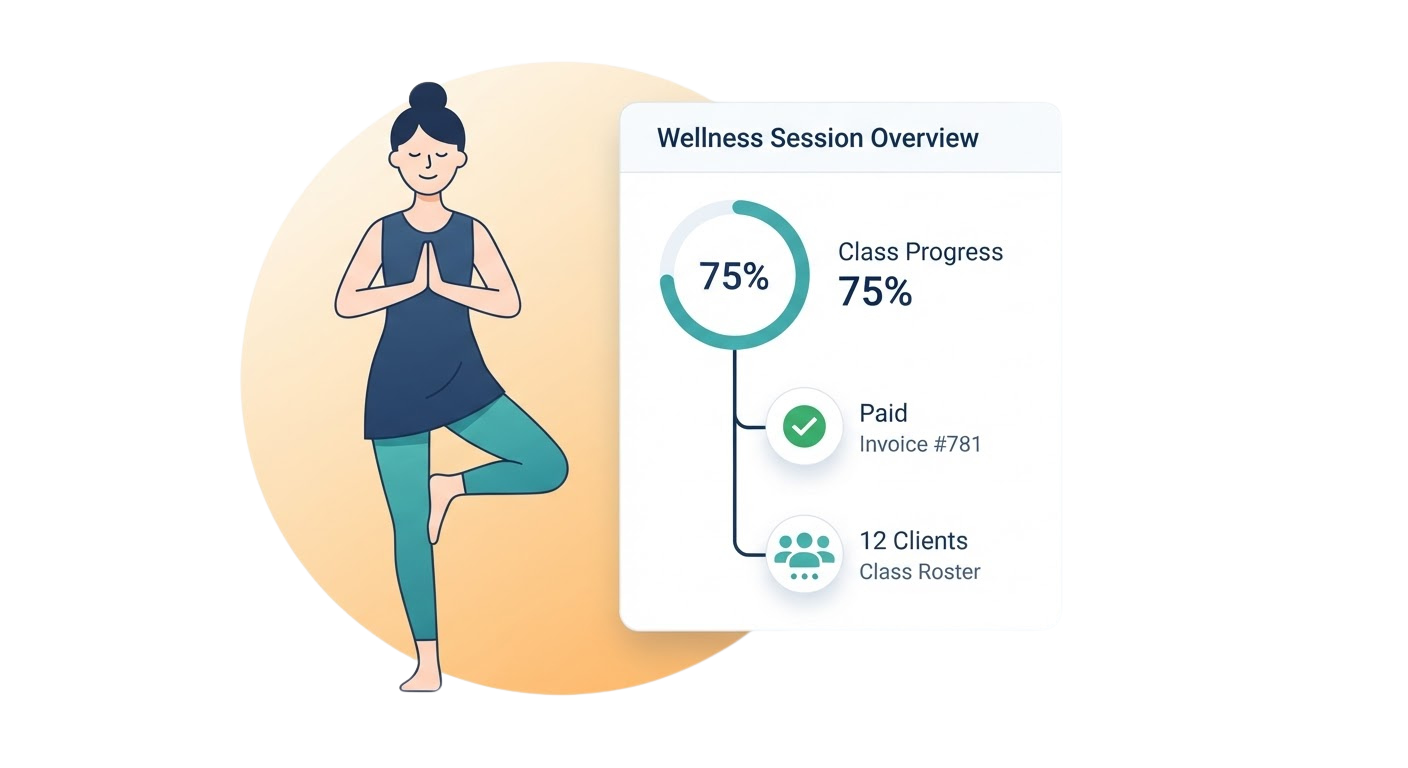
In practice, that means your clients, invoices, and payments live together. You raise an invoice for a corporate wellness session or a TTC batch, track whether it is paid or pending, and follow up without the awkward manual chase. Indian payments and international payments from your online students are tracked in one income view, so you can see what landed, what is pending, and what is truly yours. Your documents sit against the client instead of buried in WhatsApp. And GST, TDS, and income tax are handled on top of clean, year-round data with CA review built into the flow rather than bolted on in a panic every July.
The point is not another tool to check. There are fewer tools connected so the finance side of your practice quietly runs itself while you focus on teaching. As the positioning goes: your income is variabl, your tax filing shouldn't be.
The takeaway
You do not need another invoice template. You do not need another spreadsheet, another payment app, or another tax reminder buzzing in July. Those are more pieces to manage, and pieces are the problem.
What a yoga instructor in India actually needs is one connected system to manage and grow an independent teaching business - clients, invoices, payments, income, documents, and taxes in one place, with your CA in the loop. Your teaching already runs on discipline and structure. Your finances deserve the same.

Frequently Asked Questions - FAQs
How Should a Yoga Instructor In India manage their Finances?
Keep everything connected in one place- clients, invoices, payments, income tracking, documents, and taxes, instead of splitting them across apps, sheets, and chats. Clean, continuous records all year make follow-ups, cash flow, and tax filing simple.
Do Yoga Instructors in India need to register for GST?
It depends on your total turnover crossing the applicable threshold, your state, and the exact nature of your services, with some yoga-specific exemptions that may or may not apply. This is a fact-specific question, confirm your position with your CA before deciding whether to charge GST.
Do I need to Pay Advance Tax as a Yoga Instructor?
If your total tax liability for the year crosses the applicable limit, advance tax may apply in instalments through the year rather than as one payment at the end. Your CA can confirm whether it applies to you and how much, much easier when your income is tracked cleanly all year.
How do I keep track of who has paid and who is pending?
Track payments against invoices rather than from memory. When each payment is matched to an invoice, paid, partly paid, and pending statuses stay visible automatically, which is what makes timely, non-awkward follow-ups possible.
How do I handle payments from international students?
International payments through PayPal, Wise, or bank transfer arrive after fees and conversion, so reconcile what actually landed against what you were owed. Online teaching to students abroad may also be treated as an export of services with its own rules, check the specifics with your CA.
Why do corporate clients deduct TDS from my payment?
Businesses often deduct TDS on professional fees before paying you. It is not lost money, it is a credit you can claim when you file, but only if it is tracked and matches your tax credit statement. A connected system records TDS as it happens so nothing slips.
This article is for general information and doesn't constitute individual tax advice and financial advice, every individual's situation differs based on total income, client mix, and whether income includes international sources.