
Does a Freelancer in Your Profession Need GST? Rules for 25+ Jobs
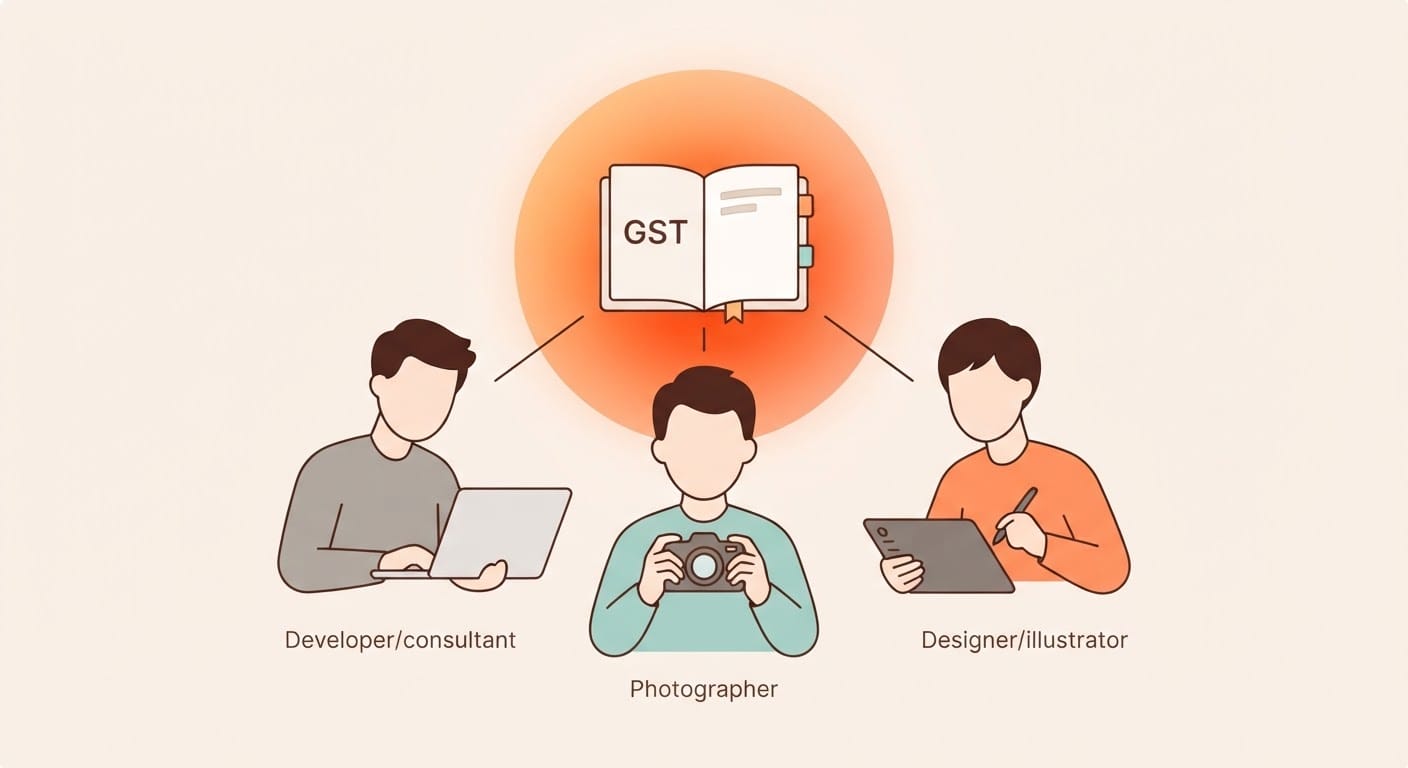
GST for freelancers in India is a tax on the services you supply, and it becomes mandatory once your aggregate turnover crosses the registration threshold - currently ₹20 lakh a year for services, or ₹10 lakh in special category states. The rate for almost all independent professional work is 18%. What changes from profession to profession is not the rate. It is whether an exemption reaches you, whether your income is an export, and whether what you sell is a service at all.
Whether a freelancer needs GST does not change simply because they are a designer, developer, creator, consultant or trainer. What can change is the nature of the service, SAC classification, client location and whether the work qualifies as an export. This guide shows how those rules play out across 25+ professions.
Who needs GST registration in India?
Almost every GST question an independent professional asks resolves to one of four tests. Work through them in order and you will land on your answer regardless of what you do for a living
1. The turnover test. GST registration is triggered by turnover, not profit. Aggregate turnover means everything received on the same PAN across every income stream : Indian clients, foreign clients, domestic and export, service income and any goods you sell. A designer billing ₹14 lakh to Indian agencies and ₹8 lakh to a US startup has ₹22 lakh of aggregate turnover and needs to register, even though the export half carries no GST.
2. The export test. Services supplied to a client outside India are zero-rated, not exempt. The distinction matters: zero-rated means you charge 0% but stay inside the system and can claim input tax credit and refunds. To export without paying IGST upfront you file a Letter of Undertaking. You also need proof the money came in as foreign exchange, which is what a FIRC or e-BRC does.
3. The exemption test. This is where most wrong advice sits. Health care, education and performing arts all carry GST exemptions, and in every case the exemption attaches to what you are registered as, not to the subject you teach or treat. Teaching yoga does not make you exempt. Being a registered charitable entity that teaches yoga might. The distinction is the whole game.
4. The OIDAR test. If what you sell downloads or streams automatically with minimal human involvement, a recorded course, a Notion template, a preset pack, a stock photo then you may be in OIDAR territory, which carries its own registration logic. Deliver the same knowledge live over a call and you are back to being an ordinary service provider.
GST by profession: where you actually fall
Below is the answer for the professions we see most often across Variabl. Find yours, then check the catch, that second line is usually the part that costs people money.
Freelancers and service providers :
| Profession | GST registration | Common SAC* | Indian client | Foreign client | Key issue |
|---|---|---|---|---|---|
| Graphic / UX / product designers | Above ₹20L aggregate turnover (exports count) | 998391 | 18% | Zero-rated, LUT | Downloadable templates may be OIDAR, not design |
| Software developers / web-app builders | Above ₹20L (exports count) | 998314 | 18% | Zero-rated, LUT | Reselling hosting, domains or licences is a separate supply |
| Writers, editors, translators, copywriters | Above ₹20L | 998394 / 998395 | 18% | Zero-rated, LUT | Royalty vs per-article fee are different supplies |
| Marketing / SEO consultants | Above ₹20L; register within 30 days of crossing | 998371 / 998311 | 18% | Zero-rated, LUT | Retainers can push you past ₹20L mid-year unnoticed |
| Social media managers | Above ₹20L | 998371 | 18% | Zero-rated, LUT | Client ad spend on your card lands in taxable value unless pure agent |
| Videographers / photographers | Above ₹20L | 998381 | 18%; place of supply follows event location | Zero-rated, LUT | Goa wedding billed from Bengaluru may be IGST, not CGST + SGST |
| Voice-over artists / podcast producers | Above ₹20L | 999631 / 999611 | 18% | Zero-rated, LUT | Buyout / perpetual licence ≠ session fee |
| Business, finance, legal consultants | Above ₹20L; RCM doesn't remove it | 998311 / 998212 | 18%; advocate → business entity is reverse charge | Zero-rated, LUT | Under RCM the client pays tax but you still register and report |
| Coaches, mentors, trainers | Above ₹20L | 999293 | 18%; no education exemption | Zero-rated, LUT | Recorded program flips you into OIDAR |
No special rule reaches this group. The work is a standard taxable service and the answer is the same whether you write, design or build, 18% above the threshold, zero-rated on exports.
Creators and digital entrepreneurs
| Profession | GST registration | Common SAC* | Indian client | Foreign client | Key issue |
|---|---|---|---|---|---|
| YouTubers | Above ₹20L; AdSense alone can cross it | 998365 / 998371 | Brand deals 18% | AdSense = export, zero-rated | Both streams share one threshold even if you charge no GST |
| Instagram influencers / Reels creators | Above ₹20L | 998371 | 18%; barter is consideration | Zero-rated, LUT | GST due on gifted product value; nobody records it |
| Podcasters, bloggers, newsletter writers | Above ₹20L | 998365 / 998431 | Sponsorship 18%; body-corporate sponsor may be RCM | Platform payouts = export | Paid subscriptions may be OIDAR depending on delivery |
| Online educators / course creators / tutors | Above ₹20L; OIDAR has own logic | 999293 live / 998434 recorded | Live class 18%; recorded course likely OIDAR | Zero-rated, LUT | Record a live session, sell it later, treatment flips |
| Indie musicians, artists, DJs | Above ₹20L | 999631 | 18% | Zero-rated, LUT | Performing-artist exemption is folk/classical only, per-performance cap, never brand work |
| Streamers (Twitch, gaming, esports) | Above ₹20L | 999631 / 998365 | Tips, donations, super chats 18% | Platform payouts = export | Whether a "donation" is consideration is a real question |
| AR/VR creators / 3D artists | Above ₹20L | 998391 / 998314 | Commissioned work 18%; marketplace assets likely OIDAR | Zero-rated, LUT | Royalty-per-download ≠ one-off commercial licence |
The hardest group, because a single creator usually has three or four income streams with three or four different treatments, and one shared threshold across all of them.
Solopreneurs and independent professionals
| Profession | GST registration | Common SAC* | Indian client | Foreign client | Key issue |
|---|---|---|---|---|---|
| Independent lawyers, accountants, CAs | Above ₹20L; RCM doesn't remove it | 998212 / 998222 | 18%; advocates → business = RCM | Zero-rated, LUT | CAs and accountants are not covered by the advocate RCM |
| Health & fitness trainers, yoga instructors | Above ₹20L | 999723 | 18%; not exempt | Zero-rated, LUT | Yoga exemption attaches to charitable entities; fitness is not health care |
| Therapists, counsellors, wellness coaches | Above ₹20L unless exempt | 999312 clinical / 999723 wellness | Recognised medical practitioner may be exempt; life coach 18% | Zero-rated (if taxable) | Exemption tracks qualification and setting, not therapeutic intent |
| Architects / interior designers | Above ₹20L | 998321 / 998391 | 18%; place of supply follows property | Zero-rated, LUT | Supplying furniture or materials creates composite/mixed supply |
| Event planners / wedding photographers | Above ₹20L | 998596 / 998381 | 18%; event place-of-supply rule | Zero-rated, LUT | Vendor costs sit in your taxable value unless pure agent |
| PR consultants / brand strategists | Above ₹20L | 998311 / 998371 | 18% | Zero-rated, LUT | Equity or revenue share instead of a fee is still consideration |
The only group where a real exemption might reach you, and the group where the most confident wrong advice circulates.
Small and boutique agencies
| Profession | GST registration | Common SAC* | Indian client | Foreign client | Key issue |
|---|---|---|---|---|---|
| 2–15 member creative studios | Usually past threshold, registered | 998391 | 18%; ITC on software, rent, equipment | Zero-rated, LUT | Contractors' GST status decides your credit on their invoices |
| Digital marketing / ad agencies | Registered | 998371 | 18% | Zero-rated, LUT | Pure agent: GST on fee vs fee + entire media budget |
| Content production houses | Registered | 999612 | 18%; ITC on hire, locations, crew | Zero-rated, LUT | Shooting in an unregistered state raises place-of-supply questions |
| Design / branding shops | Registered | 998391 | 18%; multi-state retainers | Zero-rated, LUT | Wrong CGST/SGST vs IGST call is fixable only before filing |
| Niche consulting firms | Registered | 998311 | 18% | Zero-rated, LUT | Mixed domestic/export means LUT plus ITC refund claims left unclaimed |
Once you are a registered entity with a team, the threshold question usually answers itself. The live issues become input credit, pass-throughs and interstate supply.
Once you are registered, what changes
Registration is the smaller half of the job. From the day your GSTIN is issued you are raising tax invoices with a fixed set of mandatory fields, using the right SAC code for your service, charging CGST and SGST or IGST depending on where the supply lands, and filing GSTR-1 and GSTR-3B on a schedule that does not care how your month went.
For most independents the hard part is not the filing. It is that the information needed to file is scattered, some income in a bank account, some on a platform dashboard, some in a payment gateway, some in a Google Sheet that stopped being accurate in July. You cannot file accurately on numbers you cannot see.
That is the actual sequence: know what you earned and from where, raise invoices that already carry the right tax treatment, and let the filing fall out of records that were correct when they were created.
Other Related Articles :
1) GST for Freelancers in India : The ₹20L rule explained simply
2) How To Create Invoices as a Freelancer : GST and Non-GST Format
Frequently Asked Questions - FAQs
Do freelancers need GST registration in India?
Only once aggregate turnover crosses ₹20 lakh in a financial year, ₹10 lakh in special category states. Below that, registration is voluntary. Many exporters register voluntarily anyway to file an LUT and claim input tax credit refunds.
What is the GST rate for freelancers?
18% for almost all independent professional services : design, development, writing, consulting, marketing, photography, training. Exemptions exist for some health care and some classical performance, but they are narrow and attach to your registration rather than your subject matter.
Do I need GST if all my clients are foreign?
Not below the threshold. Exports of services are zero-rated, so you charge 0% either way. But export income still counts towards the ₹20 lakh figure, so you can become liable to register while never charging GST to a single client.
Is GST applicable on YouTube income in India?
YouTube ad revenue comes from Google's overseas entity and is generally treated as an export of services, so it is zero-rated. Brand deals with Indian companies are domestic supplies at 18%. Both count towards the same registration threshold.
What is the difference between exempt and zero-rated?
Exempt means the supply is outside GST and you cannot claim input tax credit on costs. Zero-rated means the supply is inside GST at 0%, so you keep full input credit and can claim refunds. Exports are zero-rated, which is the better of the two.
his article is for general information and doesn't constitute individual tax advice and financial advice, every individual's situation differs based on total income, client mix, and whether income includes international sources.