
Finance for Freelance Software Developers in India : Why the amount you invoice is never the amount that lands.
You build data systems for clients, then keep your own income in five tabs. Here's what actually happens between the invoice you send and the money that lands.

You build systems for a living. Dashboards, pipelines, admin panels, billing integrations - if a client's data is scattered, you're the person they hire to make it coherent. Which makes the state of your own money data a little awkward.
Because here's what a month of freelance development income actually looks like. A milestone payment released on Upwork - minus the platform's cut. A retainer from a Bengaluru startup - minus the tax they deducted at source. A direct transfer from a US client through Wise - converted at whatever the rate was that Tuesday. A trickle of revenue from a plugin you built two years ago. Maybe a GitHub Sponsors payout you keep forgetting exists.
Five income events. Five different amounts shaved off before the money reached you. Five different places where the real number lives - a platform dashboard, a payout report, a bank statement, a payment-gateway export, an email you starred and never opened again.
The number you invoiced and the number that landed are never the same, and no single system you own can tell you the difference. That gap, invoiced versus received is the entire finance problem for freelance developers. Everything else, including tax, is downstream of it.
The deductions happen before you ever see the money
A salaried developer sees one deduction: whatever their pay slip says. A freelance developer's income gets shredded in transit, by different hands, at different stages, with different paperwork for each cut:
• Platform fees. Upwork, Toptal, Fiverr and their peers take their percentage before the payout hits your account. Your "earnings" screen and your bank credit are two different numbers, and only one of them is real.
• Forex conversion. A dollar invoice becomes a rupee deposit at a rate you didn't choose, minus a conversion spread and sometimes a wire fee. The gap between the mid-market rate and what landed is a real cost — one almost nobody records.
• Tax deducted at source. Indian clients deduct TDS before paying you. That money isn't gone, it's sitting against your PAN, waiting to be claimed at filing time. But only if your records show it was deducted, by whom, and against which invoice.
• Milestone releases. A fixed-price project worth one amount arrives as three or four partial releases across months. Each partial payment looks like a separate income event unless something ties them back to the same project.
Each of these is small on its own. Together, across a year, the difference between what you billed and what you banked is a genuinely large number, and if you can't see it, you can't price against it, claim it, or plan around it.
One profession, five kinds of income
Freelance development also rarely stays one kind of income for long. A typical independent developer a few years in is juggling some mix of:
• Project work : fixed-price builds, usually milestone-billed, often through a platform.
• Retainers : monthly arrangements with one or two anchor clients, the closest thing to a salary you have.
• Hourly contracts : tracked in one tool, invoiced from another, paid through a third.
• Product income : a SaaS side project, a paid plugin or theme, an app with a few hundred paying users. Small, recurring, and administratively nothing like services income.
• Everything else : sponsorships, technical writing, a paid workshop, an open-source support contract.
These streams behave differently in every way that matters. They arrive on different schedules, through different rails, with different documents attached and, as your CA will tell you, several of them are treated differently for tax. Which is precisely why they can't live in five separate silos with a memory of "roughly what came in" holding it all together.
The irony is hard to miss. If a client described this setup to you, five data sources, no common schema, no single source of truth, reconciliation done by scrolling, you'd quote them for a data pipeline. You just haven't built one for yourself.
The subscription bleed on the expense side
Developers also carry an expense profile most freelancers don't: a long tail of small, recurring, mostly-dollar-denominated subscriptions. Hosting. Domains. A code editor license. An AI coding assistant. API credits. A design tool you use twice a month. Monitoring for that side project. Most of it billed to a card in USD, converted silently, and never itemized anywhere.
Individually these are trivial. Collectively they're one of your largest business expenses - and legitimately deductible business expenses at that. But a deduction you never recorded is a deduction you never claim. Every unlogged subscription renewal is you quietly volunteering to pay tax on money you already spent running your business.
How equipment is treated at tax time is a question for your CA, but whether it appears in your records at all is entirely on you, and it has to happen in the same year you spent the money, not in a panicked reconstruction the week before filing.
Foreign income: your best-paying clients, your messiest paperwork
For most Indian freelance developers, international clients are where the good rates are. They're also where the record-keeping stakes quietly go up.
Foreign-client income raises questions that domestic income doesn't: how the service is classified, what documents prove the money came from outside India, how platform-intermediated work is treated versus direct contracts, and what needs to be in place before you can invoice a foreign client the way the rules expect. Get the paperwork right and this income enjoys favorable treatment. Get it wrong or simply fail to keep the trail and you're arguing your own case with missing evidence.
The practical point that survives every version of the rules: the developers who handle foreign income calmly are the ones whose records already show, for every payment: who paid, from where, against which invoice, at what conversion, with which document attached. That's a tracking habit, not a tax skill.
The tax questions you can't answer without clean records
Notice what all the recurring freelance-developer tax questions have in common:
• "Do I need to register for GST?" : depends on your total income across all streams. Not one platform's dashboard. All of it, combined.
• "How do I claim the tax my clients deducted?" : depends on matching every deduction to an invoice and verifying it against what's actually deposited against your PAN.
• "Should I use presumptive taxation or maintain full books?" : depends on knowing your true income and your true expenses well enough to compare the two honestly.
• "How much advance tax should I pay this quarter?" : depends on a running picture of the year so far, not a guess extrapolated from your best month.
Every one of these is a records question wearing a tax costume. A CA can answer all of them, quickly and confidently, if your numbers are complete. What no CA can do is conjure the numbers you never captured.
Track first. Everything else compiles after.
So the order of operations for a freelance developer's finances is the same as for any system you'd design: fix the data layer first.
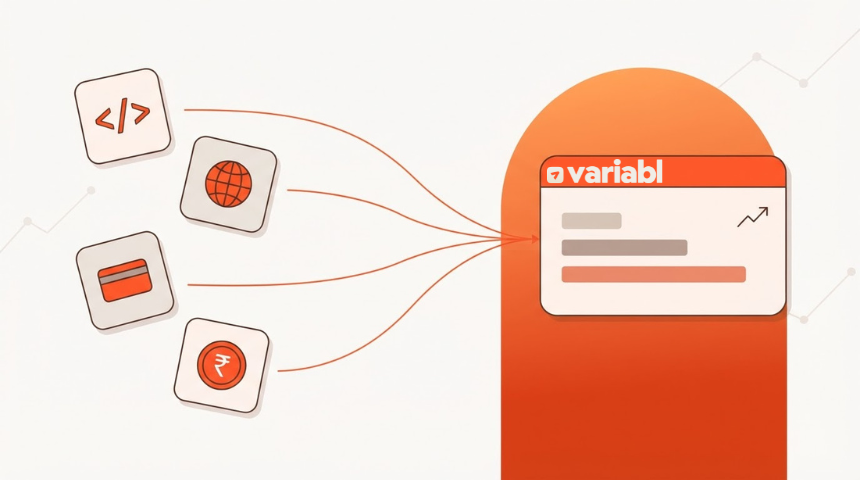
This is what Variabl is built around. One place where every income event lands: platform payouts, retainers, direct transfers, product revenue, tagged to the client and project it belongs to, with the gap between invoiced and received visible instead of vanishing into five dashboards.
Three layers, in the order you'll use them:
• The software tracks. Income by client, by stream, by month. Invoices raised from the same system that watches whether they were paid — and what was deducted on the way. Expenses, including that long tail of subscriptions, logged where they can actually be used.
• Maya assists. Variabl's AI assistant answers the "what does this mean for me" questions against your actual numbers, not a forum thread from three years ago describing someone else's situation.
• A real CA reviews and files. Registrations, filings, and the judgement calls, export treatment, presumptive eligibility, deduction claims, handled by a chartered accountant who can see your clean records instead of interrogating your memory in March.
No spreadsheet you keep abandoning in week three. No end-of-year archaeology through payout emails. The system keeps count; the humans who need the numbers, you, Maya, your CA all read from the same source of truth.

Frequently Asked Questions - FAQs
Why is the amount I receive always less than the amount I invoice?
Because the deductions happen in transit : platform fees, currency conversion spreads, wire charges and tax deducted at source by Indian Clients. Each is taken by a different party at a different stage. Tracking the invoiced vs received gap per payment is the only way to see what freelancing actually pays you.
Do I need to register for GST as a Freelance Software Developer?
It depends. If your total turnover in the financial year crosses the 20 Lakh threshold then you are eligible for GST and you have to pay it every month. If your total turnover is less than 20 Lakh then you do not to need register for GST. Always check your numbers with your CA.
What records should I keep for foreign client payments?
At minimum: the contract or engagement terms, every invoice, proof the payment came from outside India, and the conversion details of what actually landed. The exact prescribed document set is one to confirm with a CA, but the habit of attaching documents to payments as they happen is universal.
How should I track income from a side product or SaaS alongside client work?
Separately tagged, in the same system. Product revenue behaves differently from services income, different schedule, different documents, and potentially different tax treatment, so blending them into one undifferentiated pile makes both harder to report.
Can I claim the TDS my Indian clients deducted as a Freelance Software Developer in India?
Tax deducted at source is credited against your PAN and adjusts what you owe at filing - provided your records match each deduction to the invoice it came from and you verify the deposits. Clean invoice-level tracking is what makes this routine instead of a dispute.
How is income from Upwork or other platforms taxed differently from direct clients?
Platform-mediated income can raise classification and documentation questions that direct contracts don't, especially for foreign clients.
This article is for general information and doesn't constitute individual tax advice and financial advice, every individual's situation differs based on total income, client mix, and whether income includes international sources.